
From Anti-Aging Correction to Skin Longevity
Authors
Mathias Gempeler Ph.D. – Global Head Science & Promotion Skin Care. Francesca Pascucci – Global Director Marketing Skin Care.
The contemporary skin care paradigm is undergoing a transition from a largely cosmetic “anti-aging” narrative to a biology-anchored skin longevity framework that aims to maintain
structural and functional skin integrity across the lifespan. A recent multiethnic study in women aged 50–65 years showed that, at identical chronological age, perceived age can diverge by more than a decade depending on skin texture, evenness of pigmentation and wrinkle severity, indicating that preservation of youthful skin morphology prolongs the perception of youth [1].
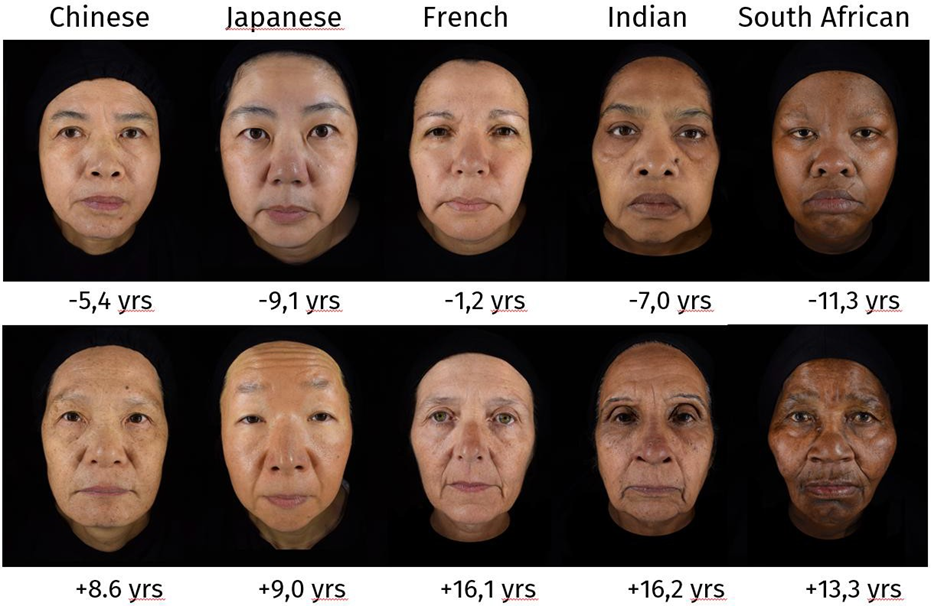
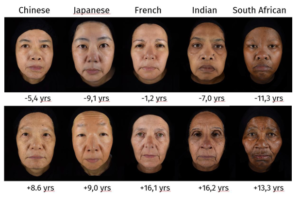
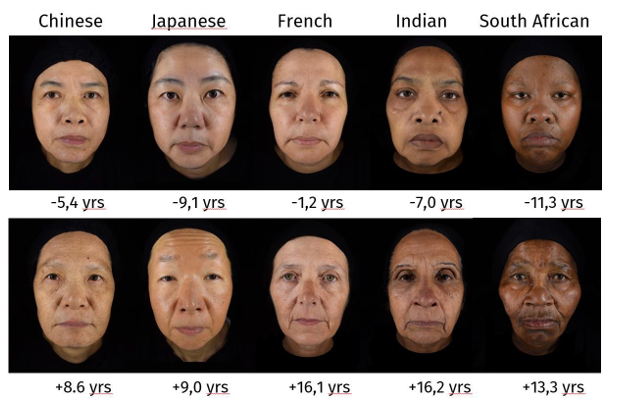
Figure 1. Differences between estimated and chronological age in women aged 50-65 years across five ethnic groups. Women in each column have the same chronological age, with numbers showing how many years older (+) or younger (-) they were perceived compared to their actual age
Hallmarks of aging and the central role of senescence
The classical dichotomy of intrinsic versus extrinsic aging has been superseded by the twelve hallmarks of aging, a unifying framework that describes conserved molecular and cellular processes [2]. These hallmarks are highly interconnected; disruption of one node can propagate through the network, amplifying tissue dysfunction and ultimately driving organismal aging and age-related diseases [3].
Cellular senescence occupies a central position in this framework with direct relevance for cutaneous aging. Senescent cells are characterized by irreversible cell-cycle arrest, resistance to apoptosis, chromatin reorganization, increased lysosomal β-galactosidase and a senescence-associated secretory phenotype (SASP) rich in pro-inflammatory cytokines, chemokines, growth factors and matrix metalloproteinases. The SASP disrupts tissue homeostasis, degrades extracellular matrix (ECM), fuels chronic low-grade inflammation (inflammageing), exhausts stem/progenitor cell pools and can induce paracrine senescence in neighboring cells [4]. Their presence correlates with reduced collagen and elastin content, impaired repair capacity, enlarged pores and wrinkle formation, making senescent cell burden a key determinant of skin biological age.
Senolytic intervention: ETERWELL™ YOUTH
The emergence of senolytic and senomorphic strategies has transformed cellular senescence from a passive biomarker into an actionable target for both medical and cosmetic intervention.
Using systematic screening platforms, dsm-firmenich identified ETERWELL™ YOUTH, a fully sustainable senolytic extract derived from the alpine plant Epilobium fleischeri. Mechanistic investigations indicate that ETERWELL™ YOUTH down-regulates anti-apoptotic B-cell lymphoma 2 (BCL-2) in senescent cells, shifting the balance toward intrinsic apoptosis and facilitating their clearance via physiological mechanisms.
These findings led to a two-step longevity concept: (i) senolytic pre-conditioning to remove “biological roadblocks” imposed by senescent cells and SASP, followed by (ii) targeted delivery of conventional actives, such as collagen-boosting peptides, into a senescence-depleted microenvironment for enhanced efficacy.
Collagen-centric peptide technology: SYN®-COLL CB
Collagen degradation and impaired neocollagenesis are core features of dermal aging and represent a convergence point for multiple hallmarks, including senescence, mitochondrial dysfunction and altered ECM remodeling. SYN®-COLL CB (Palmitoyl Tripeptide-5) is a rationally designed, pharma-inspired tripeptide that modulates transforming growth factor-β (TGF-β) signaling to stimulate collagen synthesis and improve matrix organization.
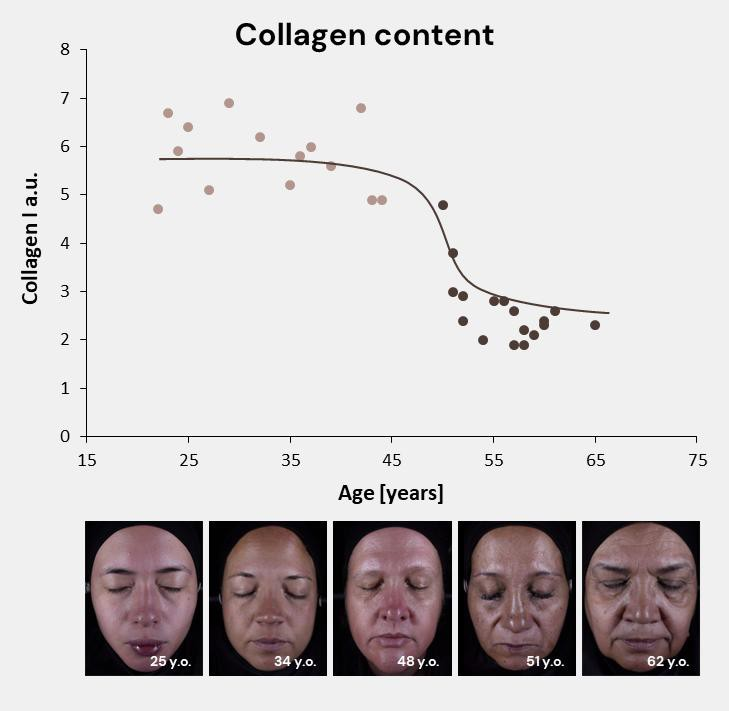
Figure 3: As collagen levels decrease over time, signs of skin aging appear [5] Images taken in dsm-firmenich 2024 clinical study.
New data extend its profile as a life-course collagen modulator. In a 28-day facial study, female volunteers were stratified into young (25–35 years), middle-aged (36–50 years) and mature (51–65 years) cohorts (n = 25 per cohort, phototypes II–V, mixed ethnicities), alongside a placebo group (n = 30). Age-adapted SYN®-COLL CB concentrations (1%, 2.5%, 5%) were applied twice daily to the full face and neck. High-frequency ultrasound at multiple facial sites showed statistically significant increases in collagen density versus age-matched placebo in all
cohorts, with >7% gain at 1% in young subjects and >26% at 5% in mature skin.
Three-dimensional facial color mapping visualized region-specific increases in dermal collagen content.
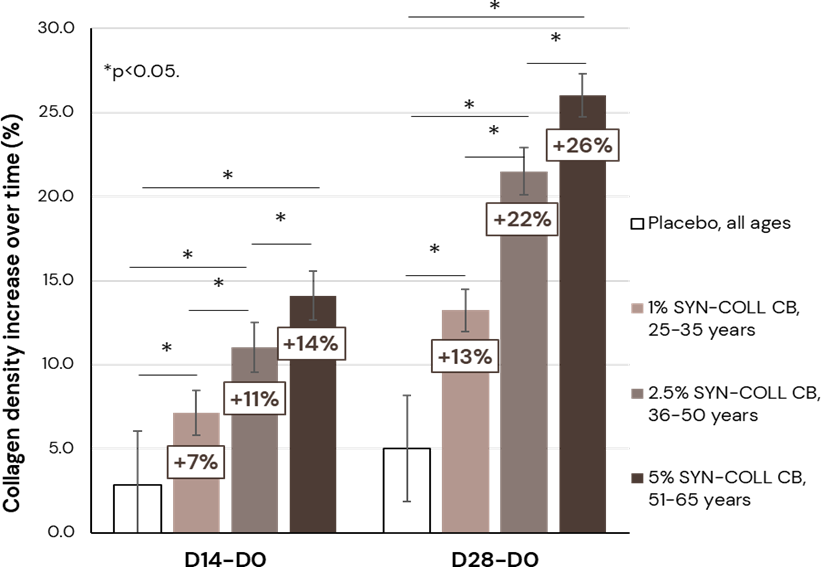
Figure 4: Significant changes in collagen reserves observed in all age. Changes are significant over time and between groups at all timepoints and against placebo.
Clinical proof of senolytic-peptide synergy
The senolytic-peptide concept was clinically tested in a two-month, single-blind, randomized, half-face study in 55 Chinese women aged 45–65 years. Each volunteer applied a formulation containing 1.5% Palmitoyl Tripeptide-5 to one hemiface and an otherwise identical formulation with 1.5% Palmitoyl Tripeptide-5 plus 1.0% ETERWELLTM YOUTH to the contralateral side, twice daily. Ultrasound measurements showed that while the peptide alone significantly increased collagen density relative to untreated skin, the combination with ETERWELLTM YOUTH produced approximately a 200% greater increase.
Pore number and pore volume, highly age-salient parameters in Asian skin, were quantified using image analysis and Antera 3D imaging.
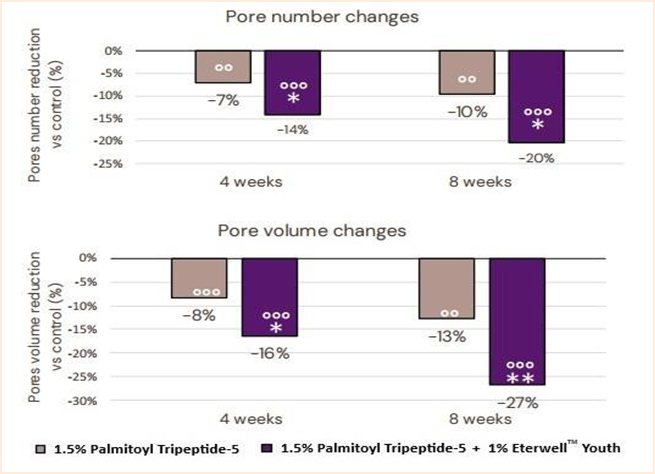
Figure 5: The test product with Palmitoyl Tripeptide-5 alone produced significant improvement in pore number and volume (-7% and -8% respectively), when compared to the untreated skin. However, as with collagen density, these improvements were boosted when 1.5% Palmitoyl Tripeptide-5 was combined with 1.0% ETERWELLTM YOUTH.
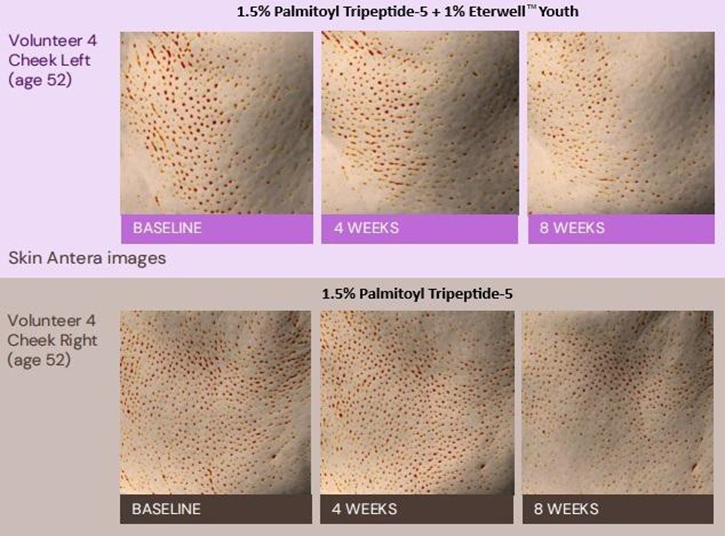
Figure 7. Antera 3D® images showing the effects of 1.5% Palmitoyl Tripeptide-5 alone and in combination with 1.0% ETERWELLTM YOUTH on one volunteer’s Pore size and volume.
Conclusion
The beauty industry’s transformation from anti-aging to skin longevity represents more than just a shift in terminology. It is a fundamental change in how we approach skincare. It plugs into skin biology for targeted, effective, personalized solutions.
While the development of senolytic technology like EterwellTM Youth marks an important advancement in cellular science, the most significant breakthrough lies in the discovery that senolytics can dramatically enhance the performance of traditional skincare ingredients. Today, clinical evidence shows that senolytic compounds can double the efficacy of established actives—such as collagen-boosting peptides—by amplifying their impact on the main visible signs of aging. By removing the biological roadblocks that limit conventional actives’ effectiveness, senolytic-enhanced formulations represent the future of evidence-based skincare.
As the industry continues to embrace this holistic, science-driven approach, consumers can expect increasingly sophisticated solutions and truly personalised advanced skincare that does not just address the visible signs of aging but actively support skin’s long-term health and resilience. This is the promise of skin longevity, not the impossible pursuit of perfection, but the achievable goal of looking and feeling your best throughout life.
References
1. Voegeli R, et al. Int J Cosmet Sci. 2021;43(5):547–560. 2. López-Otín C, et al. Cell. 2023;186(2):243–278.
- Tenchov R, et al. ACS Chem Neurosci. 2024;15(1):1–30.
- Dodig S, et al. Biochem Med (Zagreb). 2019;29(3):030501.
- Affinito P, et al. Maturitas. 1999 Dec 15;33(3):239-47.
beautycare.communications@dsm-firmenich.com dsm-firmenich.com