The skincare industry has never had a shortage of products. If anything, the problem is the opposite — too many choices, too much conflicting advice, and routines built on guesswork rather than genuine skin knowledge. For years, consumers have relied on generic skin type labels (dry, oily, combination) and hoped for the best. That era is coming to an end.
Artificial intelligence (AI) is fundamentally changing how people understand their skin and how brands deliver recommendations. What was once only possible in a dermatologist’s office is now available at scale, in real time, directly in a consumer’s hands. Here’s how it works — and why it matters.
The Limits of Traditional Skincare Advice
Walk into any beauty retailer and a trained advisor will ask you a few questions, look at your skin under a light, and suggest a routine. It’s well-intentioned, but it’s also inconsistent, subjective, and impossible to scale online. E-commerce brands have historically relied on self-reported quizzes — “Is your skin oily by midday?” — which depend entirely on how accurately a user knows their own skin.
The result is predictable: mismatched products, underwhelming results, and a purchase the consumer is stuck with — since most retailers won’t accept returns on open skincare. For brands, that means no repurchase and eroded trust. For consumers, it means frustration and a growing skepticism toward skincare claims.
AI addresses this gap by replacing guesswork with data.
What Is AI-Powered Skin Analysis, and How Does It Work?
AI skin analysis uses any camera-equipped device — smartphone, tablet, or in-store kiosk — to capture an image of the face and process it through advanced computer vision models. The output isn’t just a skin type — it’s a detailed diagnostic across multiple dimensions.
Computer Vision and Facial Mapping
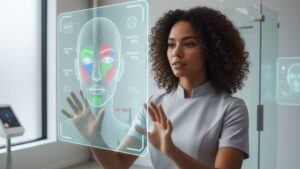
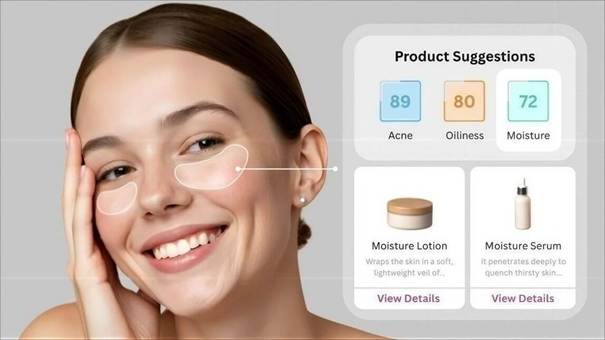
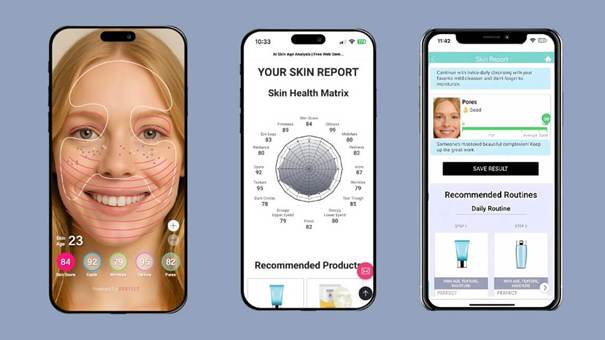
AI models detect and measure specific skin concerns — pore size, texture irregularities, wrinkles, dark spots, redness, oiliness, lack of moisture and much more. This process is fast (only few seconds), non-invasive, and far more consistent than any manual assessment.
With the ability to detect up to 15 skin concerns, plus skin type and skin age, Perfect Corp’s AI Skin Analysis delivers one of the most comprehensive diagnostics available on the market. It can also create before/after skin simulations on a user’s face for 7 skin issues to visualize and track progress of treatments. Also, thanks to a unique 180° full face mapping, this ultra-precise solution ensures full facial coverage, including difficult-to-map areas like the chin and cheeks.
📎 Discover Perfect Corp’s AI Skincare Solutions for Brands
Machine Learning Trained on Thousands of Images
The accuracy of these models comes from training. Perfect Corp’s AI skin technology is built using over 70,000 medical grade images. Results have been proven to be accurate at identifying skin concerns in a medical study, displaying a 95% test-retest reliability rate.
From Diagnosis to Recommendation — Closing the Gap
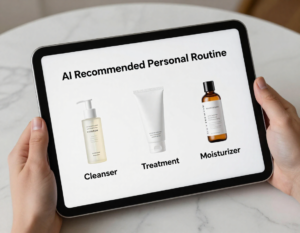
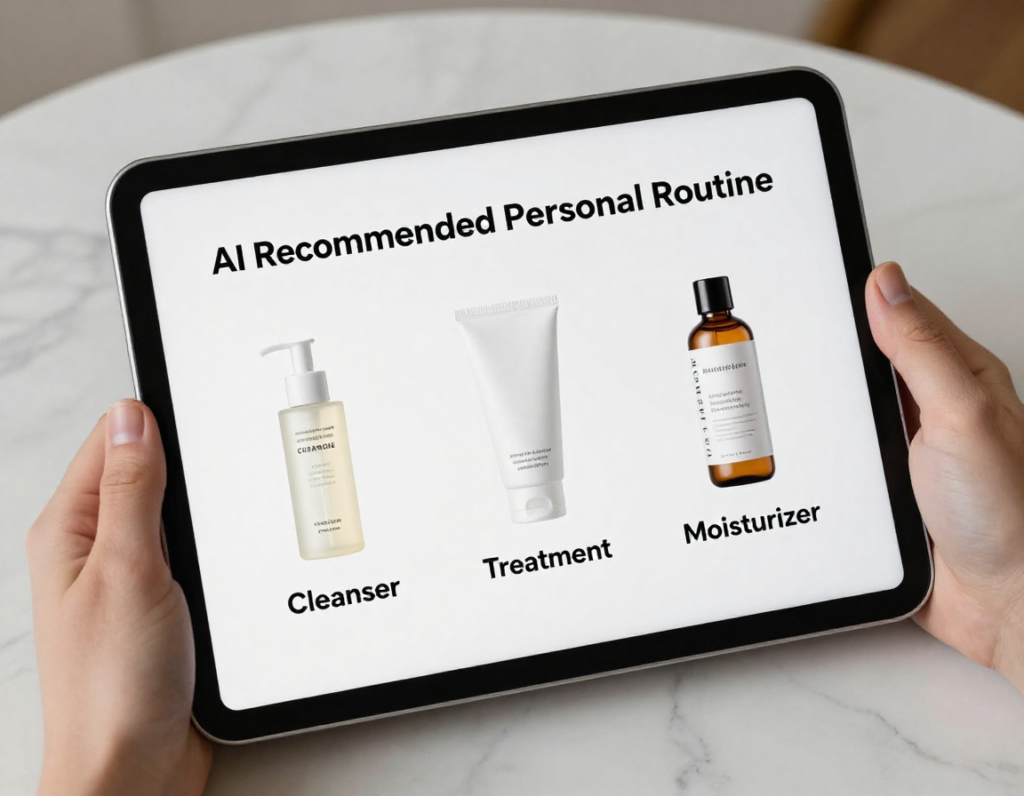
Analysis is only valuable if it leads somewhere. The real power of AI in skincare lies in what happens after the diagnostic: translating skin data into actionable, personalized recommendations.
Hyper-Personalization at Scale: Perfect Corp’s AI Skincare Recommender
Once a user’s skin profile is established, AI can instantly map their specific concerns to the most relevant products in a brand’s catalog by scanning and analyzing product data—such as names, descriptions, images, and categories. This level of personalization would be impossible to deliver manually at any meaningful scale. A brand serving 100,000 online visitors cannot staff enough advisors to consult each one. AI can.
Real-Time Skin Progress Tracking
Beyond the first recommendation, AI enables ongoing skin journey tracking. Users can re-analyze their skin over weeks and months to measure improvement which deepens engagement, reinforces product effectiveness, and builds long-term brand loyalty.
📎 Discover Perfect Corp’s AI Skincare CRM features for instore
The Business Impact for Skincare Brands and Retailers
For beauty brands and retailers, integrating AI skin analysis isn’t just a technology upgrade — it’s a strategic lever.
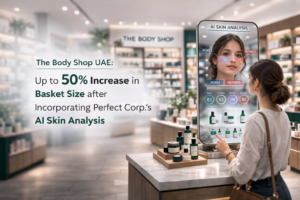
Personalized recommendations consistently drive higher conversion rates. When a consumer feels that a product was chosen specifically for their skin, they are significantly more likely to purchase. The same logic leads to repurchase: a recommendation grounded in real skin data is far more likely to meet expectations than a generic best-seller suggestion.
There is also a first-party data advantage: AI skin diagnostic tools create a compliant, consent-based way to gather rich consumer insights — skin concerns, product preferences, engagement patterns — that can inform product development, marketing, and inventory decisions.
📎 See how Perfect Corp helps beauty brands grow
What’s Next? The Future of AI in Skincare
The current generation of AI skin analysis tools is impressive, but the trajectory points toward even greater depth. The convergence of beauty, technology, and health is accelerating. Brands that build AI capabilities now will be positioned to lead as consumer expectations continue to rise.
Ready to Bring AI Skincare to Your Brand?
AI skin analysis is no longer a differentiator reserved for the largest players in beauty. It is an accessible, scalable solution that brands of all sizes can integrate into their digital and in-store customer experience.
Perfect Corp offers industry-leading AI and AR beauty technology, trusted by over 800 beauty brands worldwide. Whether you’re looking to enhance your e-commerce experience, empower in-store consultations, or build a deeper understanding of your consumers’ skin, the tools are ready.